
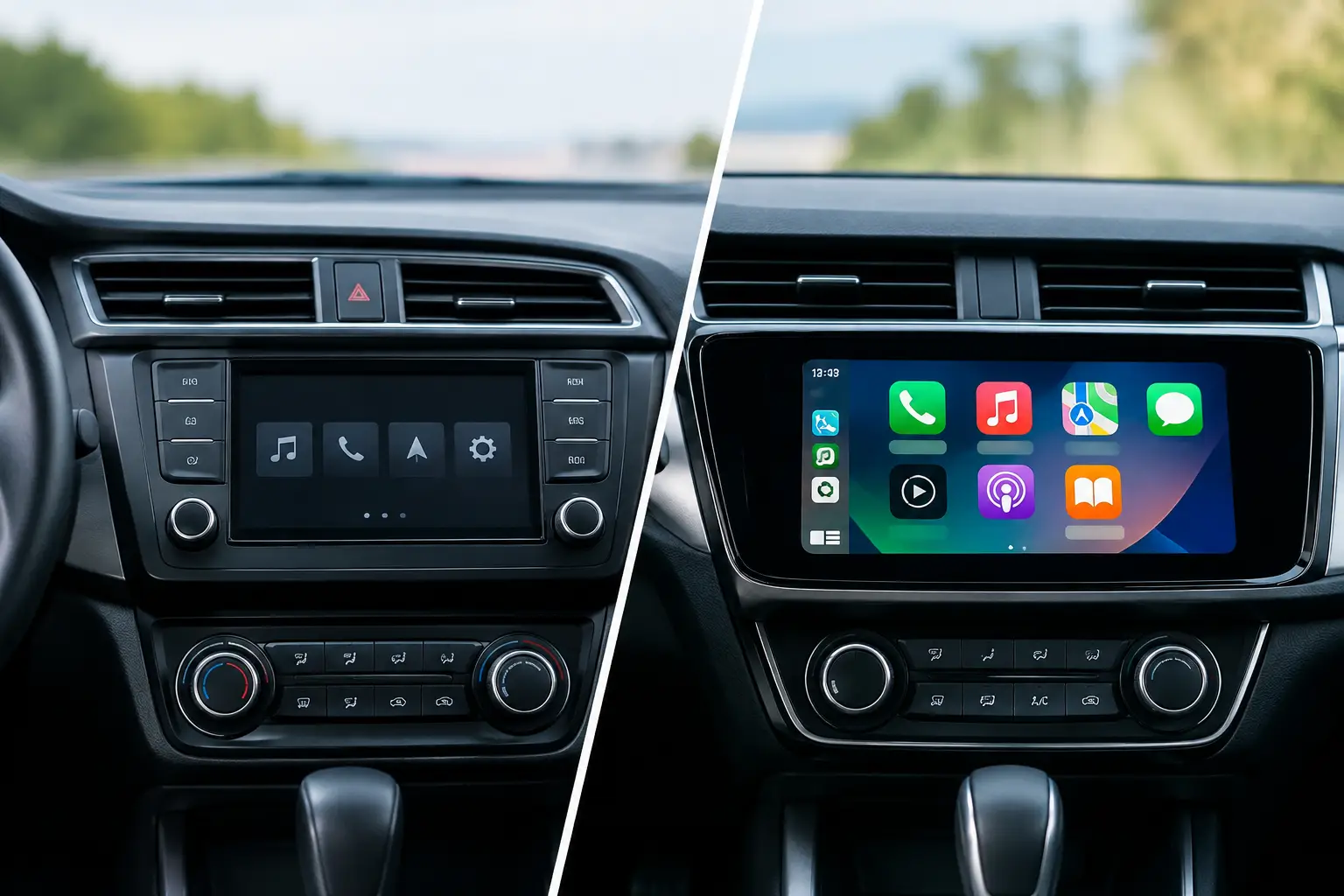
Your truck may have a factory stereo that still works perfectly, but “works” and “keeps up with your life” are not always the same thing. The factory stereo versus CarPlay decision usually comes down to what happens after you leave the driveway: navigating Las Vegas traffic, taking calls hands-free, streaming music, running a radar app, or backing into a tight parking spot with a camera view.
For some drivers, the OEM radio is the right move. For others, Apple CarPlay turns an older cabin into a place they actually want to spend time. The best answer is not automatically “replace it.” It is choosing the setup that fits your vehicle, your budget, and how you use the ride.
What a Factory Stereo Still Does Well
Modern factory stereos are more capable than many people give them credit for. In newer cars, trucks, and SUVs, the original screen often controls climate settings, vehicle menus, factory cameras, parking sensors, drive modes, and other features that go far beyond music. Pulling it out without a proper integration plan can create more problems than it solves.
OEM systems also have one major advantage: they were designed around the vehicle. The screen matches the dash, steering-wheel buttons work as intended, and the system powers up without asking you to think about it. That clean factory fit matters, especially in luxury vehicles, late-model trucks, and exotics where the dash is part of the interior design.
If your vehicle already has wired or wireless CarPlay from the factory, a full head-unit replacement may not make sense. You may get more value from better speakers, an amplifier, a subwoofer, sound treatment, a dashcam, or a camera upgrade. There is no reason to replace a functioning screen just because aftermarket gear exists.
The downside shows up most often in older vehicles and entry-level factory systems. Slow startup, weak Bluetooth, outdated navigation, limited app support, low-resolution cameras, and basic sound tuning can make a nice vehicle feel dated fast. A factory radio may be reliable, but that does not mean it delivers the features you use every day.
Factory Stereo Versus CarPlay: The Real Difference
CarPlay is not a stereo brand or a replacement unit by itself. It is Apple’s phone-based interface, displayed through a compatible factory or aftermarket screen. That distinction matters because you may be able to add CarPlay while keeping the factory radio, or you may need a full aftermarket receiver depending on your vehicle.
The main benefit is familiarity. Your maps, calls, messages, podcasts, playlists, and supported apps live on your iPhone already. CarPlay puts the functions you actually use on a larger, driver-friendly screen, with Siri handling many commands so your hands can stay on the wheel.
Navigation is where the upgrade earns its place for most Southern Nevada drivers. Factory navigation systems can be expensive to update, while CarPlay lets you use current map data and live traffic through your preferred supported app. Whether you are heading across town, running errands around Henderson, or driving out toward the lake, a current route and clear directions are worth more than an old built-in map database.
CarPlay also makes daily communication less distracting. You can call, reply to messages by voice, or switch playlists without digging through your phone at a red light. It is not permission to stop paying attention, but it is a much better setup than mounting a phone in a random corner of the dash and hoping it stays there.
When Keeping the OEM Setup Makes More Sense
Keep the factory system when it already gives you the features you need and replacement would compromise vehicle functions, budget, or appearance. This is common with newer vehicles that already include CarPlay or Android Auto, premium factory audio, multiple cameras, and deep touchscreen controls.
A factory system can also be the better choice if you plan to sell or trade the vehicle soon. A professional upgrade can add appeal, but you may not recover the full cost of a major audio build in a short ownership window. In that case, targeted upgrades like speakers, tint, a dashcam, or a wireless CarPlay adapter may make more sense.
There is another practical point: not every aftermarket screen is an upgrade. Cheap universal units can bring laggy controls, poor screen visibility in desert sun, weak audio quality, and unreliable connections. The goal is not just to put a bigger screen in the dash. The goal is clean fitment, stable performance, and full retention of the features your vehicle came with.
When an Aftermarket CarPlay Upgrade Wins
If you drive a 2000s or early 2010s vehicle with a basic radio, an aftermarket CarPlay receiver can be one of the highest-impact upgrades you can make. It gives an older car, truck, or SUV a modern command center without taking on a new-car payment.
A properly selected unit can bring touchscreen controls, Bluetooth calling, wireless or wired CarPlay, Android Auto, camera compatibility, USB charging, better equalizer settings, and stronger audio output. Pair it with upgraded speakers, an amplifier, or a custom subwoofer box, and the difference is not subtle. Your commute, road trips, and late-night drives all feel better.
This is especially popular for trucks and SUVs that are otherwise dialed in. You can have the lift kit, wheels, lighting, tint, and aggressive stance, then step inside to a radio setup that still looks like it came from another era. CarPlay closes that gap.
Owners of classic cars and clean older builds have another option: a discreet installation that preserves the vehicle’s character. Not every project needs a flashy floating display. Some builds call for a period-friendly look with modern connectivity hidden behind the scenes. Fitment and design should match the vehicle, not fight it.
Sound Quality Is a Separate Decision
A new screen alone will not automatically turn weak factory audio into a concert system. CarPlay improves access to your music and controls, but sound quality depends on the speakers, amplifier, tuning, subwoofer, enclosure, and the way everything is installed.
Some factory premium systems use specialized amplifiers, signal processing, and unusual speaker loads. That can make integration more involved than a straightforward radio swap. A professional installer can identify what needs to be retained, bypassed, or upgraded before parts are ordered.
If sound is the priority, build the plan around sound first. Decide whether you want cleaner vocals, harder bass, more volume, or a balanced system that does everything well. Then choose a CarPlay solution that supports the audio plan instead of treating the screen as the entire upgrade.
Wired vs. Wireless CarPlay
Wired CarPlay is usually the simplest and most dependable choice. It charges your phone while connected and tends to provide a stable connection. For drivers who spend long days in the truck or regularly use navigation, wired can be the practical winner.
Wireless CarPlay is cleaner and more convenient. Get in, start the vehicle, and your phone connects without a cable. That is a great fit for short daily trips and newer interiors where you do not want cords hanging around the console. The trade-off is that wireless connections can use more phone battery, and performance depends on the receiver and your phone.
Neither is automatically better. If you are hard on your phone battery, run maps constantly, or prefer maximum reliability, go wired. If convenience and a clean cabin matter most, wireless is worth it.
Installation Is Where the Upgrade Gets Real
A clean CarPlay retrofit is more than sliding a screen into the dash. The right installation may involve a vehicle-specific dash kit, wiring harness, steering-wheel control interface, antenna adapter, camera retention module, USB routing, microphone placement, and factory amplifier integration.
That work is what separates a finished build from a dash full of warning lights, dead buttons, and loose trim. Every vehicle platform has its own quirks. A domestic truck, JDM coupe, European sedan, and exotic SUV should not be treated like the same install.
At Aftermarket Guru, the smart move is to look at the vehicle before choosing parts. That helps match the screen size, features, sound goals, factory controls, and budget to the build you actually want. It also prevents buying a receiver that technically fits but does not support the camera, steering-wheel controls, or audio system you need.
Before you choose, think about the next year of ownership, not just the next weekend. If your factory system already handles your needs, put the budget toward the upgrades you will feel most. If the radio is the weak link every time you drive, a properly installed CarPlay system can make the whole vehicle feel newer without changing what makes it yours.